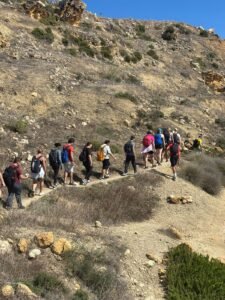
On 4 October 2025, 39 participants joined Steps & Sunsets: Gozo Hike in Gozo for an outdoor workshop focused on environmental regeneration and sustainability. Through a guided hike, biodiversity observation, litter collection, and a swimming stop, participants explored the connection between land and sea ecosystems, reflected on human impacts such as erosion and pollution, and discovered practical ways to support environmental protection through everyday actions and responsible outdoor behaviour.
Objectives:
- To explore practical ways of regenerating the environment through direct observation and action.
- To help participants understand the importance of environmental restoration and waste reduction in both land and marine ecosystems.
- To raise awareness of local biodiversity in Gozo by observing flora, fauna, and natural features along the hike.
- To encourage responsible behaviours such as litter collection, mindful interaction with nature, and sustainable use of outdoor spaces.
- To help participants reflect on the interconnectedness of land and sea ecosystems, using swimming as a way to discuss marine protection.
Desired Outcomes:
- Participants would gain a clearer understanding of what environmental regeneration meant in practice.
- They would learn to identify signs of biodiversity as well as areas suffering from environmental stress such as heat impact, erosion, and human interference.
- Participants would demonstrate active engagement in simple restoration activities, mainly waste reduction through litter collection.
- They would reflect on how they could contribute to regeneration efforts in their own communities.
- Participants would feel motivated and confident to adopt sustainable habits during outdoor activities (e.g., zero-waste hiking and responsible swimming).
Description and Implementation:
The workshop took the form of a guided hike in Gozo rather than the originally planned hands-on restoration activities such as tree planting or soil work. Throughout the hike, participants observed local flora and fauna, noted biodiversity, and identified areas affected by erosion, heat stress, and human impact. Where possible, participants collected litter and sorted it at designated stops, which replaced the more structured restoration tasks proposed in the original workshop breakdown. Another adaptation was the inclusion of a swimming stop. This incorporated an additional sport element and allowed participants to reflect on protecting marine environments, not only terrestrial ones, broadening the scope of the workshop. Discussions focused on environmental restoration, waste reduction, and practical ways to regenerate both land and sea ecosystems.
Feedback:
- Participants appreciated the outdoor, experiential format and found the Gozo environment engaging and educational.
- They highlighted that observing biodiversity firsthand made the topic of regeneration more tangible.
- Many enjoyed the combination of hiking and swimming, saying it helped them see environmental issues in a more holistic way.
- The litter-collecting aspect was described as simple but impactful.
- Some participants expressed interest in doing similar activities more often or getting involved in further local clean-ups or environmental projects.
- Several noted that they became more conscious of how their behaviour during outdoor activities affected nature.
Conclusion and Recommendations:
This is about reflecting back for the benefit of the wider STELLA project, to consider how the experience and learning from this event might be relevant to the project partners or future activities. Some recommendations:
- Continue using experiential, outdoor formats, as they proved highly effective for youth engagement.
- Incorporate both terrestrial and marine elements when possible to emphasise ecosystem interconnectedness.
- Provide simple tools or checklists for biodiversity observation to support participants with less environmental knowledge.
- If resources permit, combine hikes with small hands-on restoration tasks (e.g., planting native shrubs, restoring paths, or supporting ongoing local conservation initiatives).
- Offer follow-up opportunities so participants can turn interest into continued action (e.g., joining local clean-ups or citizen-science projects).
- Provide clearer waste-sorting stations and brief educational moments about the types of waste found.