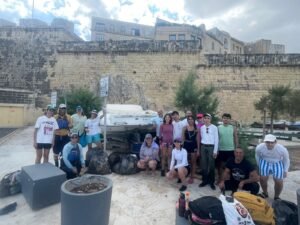
On 12 October 2025, 17 participants gathered in Kalkara, Malta, for Paddling Towards Cleaner Shores, an outdoor workshop that combined kayaking with a coastal and marine clean-up initiative. Through hands-on environmental action, participants explored the impacts of marine pollution, learned about the challenges facing local coastal ecosystems, and contributed directly to improving the marine environment while reflecting on the role individuals, communities, and institutions can play in protecting our seas.
Objectives:
- To engage young people in a hands-on environmental action through kayaking and coastal clean-up.
- To raise awareness about marine pollution, especially in areas frequented by large vessels such as cruise liners.
- To help participants understand different types of pollutants found at sea and along the coast, and how these affect marine ecosystems and water quality.
- To encourage sustainable behaviour and responsible use of coastal spaces.
- To promote teamwork, outdoor physical activity, and connection to the natural marine environment.
Desired Outcomes:
- Participants gained practical knowledge about marine pollution, its sources, and its effects.
- They contributed directly to improving the coastal environment through sea and beach clean-up activities.
- Participants reflected on their personal role in environmental protection, as well as the responsibilities of the wider community and government.
- They developed a stronger sense of environmental responsibility and increased their awareness of sustainable habits.
- The activity strengthened teamwork and provided a positive outdoor learning experience.
Description and Implementation:
The workshop took place as a kayak/rowing route combined with a sea and beach clean-up. Participants kayaked along the coastline, stopping at key points to remove marine litter from both the water and the shore. Facilitators explained the types of pollutants commonly found in the area, especially those associated with cruise liners and other large ships, and described how these pollutants affected marine life and water quality. The workshop focused on marine observation, pollution education, and practical clean-up tasks, adapting the activity to the coastal environment. Discussions revolved around what individuals and the larger community can do to help the situation, but also what can be done on a larger level by government and civil society.
Feedback:
- Participants said they enjoyed the combination of kayaking and environmental action.
- They reported that the workshop increased their awareness of marine pollution and the types of waste present in coastal areas.
- Many participants said they were surprised by the amount and variety of litter collected.
- They appreciated learning how larger vessels contributed to pollution and how different materials impacted marine life.
- Several expressed interest in taking part in similar clean-up activities in the future.
- Overall, participants gave very positive feedback and felt the experience was meaningful and educational.
Conclusion and Recommendations:
This is about reflecting back for the benefit of the wider STELLA project, to consider how the experience and learning from this event might be relevant to the project partners or future activities. Some recommendations:
- Continue integrating active outdoor sports, such as kayaking, with environmental education.
- Provide short educational materials or visuals to reinforce learning about marine pollution.
- Include a simple data-collection element (e.g., categorising waste) to support citizen science.
- Extend the reflection and discussion time to help participants identify concrete next steps, presenting ideas to the larger community, government and civil society.
- Strengthen collaboration with local coastal authorities or environmental groups to maximise long-term impact.