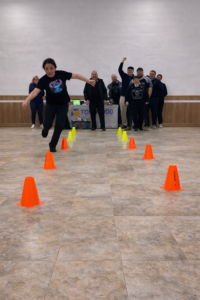
On 31 January 2026, 20 participants gathered in Għargħur, Malta, for the Waste Relay workshop, an active, sport-based learning activity designed to explore waste separation and recycling in an engaging and hands-on way.
Objectives:
- Strengthened participants’ environmental awareness, particularly around waste separation and recycling.
- Encouraged critical thinking about the materials that everyday items are made of and how these influence disposal choices.
- Used sport-based, experiential learning, in this case a relay, to make environmental education engaging, active, and memorable.
- Promoted ethical and responsible behaviour by linking physical activity with environmentally conscious decision-making.
- Stimulated discussion and peer learning about Malta’s waste management systems and the environmental impact of improper disposal.
Desired Outcomes:
- Participants would demonstrate improved understanding of correct waste separation.
- They would become more aware of ambiguous or multi-material items and the need to think before disposing.
- They would gain confidence in identifying the correct disposal points available in Malta.
- The activity would strengthen their sense of shared responsibility for environmental protection.
- The workshop would create a positive, energetic learning environment that reinforced the STELLA project’s aim of using sport as a tool for sustainability education.
Description and Implementation:
The workshop consisted of a relay race in which participants transported various pieces of “rubbish” from one box to another. Each item represented a different waste category, with some being straightforward (such as plastic bottles) and others intentionally ambiguous or made of mixed materials. This design encouraged participants to pause, think, and discuss before placing items in the “correct” box.
Adaptations included:
- The activity placed stronger emphasis on discussion during the relay, rather than only after the physical task.
- Items were selected to reflect local Maltese waste-disposal challenges, prompting conversation about where specific items should be disposed of in Malta.
Feedback:
- The activity was fun, dynamic, and engaging, making learning feel natural rather than instructional.
- They appreciated the inclusion of tricky items, which helped them realise gaps in their knowledge.
- Discussions helped clarify confusing waste categories, especially for items made of multiple materials.
- Many expressed surprise at the environmental impact of certain everyday items and felt more motivated to dispose of waste correctly.
- They valued the local relevance, noting that understanding Malta’s specific waste system made the activity more meaningful.
Results and Outcomes – Trainers/Facilitators:
The trainers learned that participants often relied on assumptions rather than knowledge when disposing of waste, especially with mixed-material items. Sport-based activities created a non-threatening environment where participants felt comfortable asking questions and admitting uncertainty. The combination of movement and discussion increased engagement and retention of environmental concepts. Additionally, there was a clear need for more accessible information about Malta’s waste disposal rules, as many participants were unsure about certain categories.
Unexpected results included a higher-than-anticipated level of debate and curiosity, as participants were eager to challenge each other and justify their choices. Some participants shared personal experiences or misconceptions, which enriched the group learning process. The physical element of the relay unexpectedly encouraged teamwork and communication, even though the primary goal was environmental learning.
The outcomes matched expectations: the activity successfully met the intended learning goals and even exceeded expectations in terms of participant engagement and depth of discussion. The relay format proved to be a simple yet effective tool for stimulating environmental reflection and reinforcing the STELLA project’s core principles.
Conclusion and Recommendations:
This is about reflecting back for the benefit of the wider STELLA project, to consider how the experience and learning from this event might be relevant to the project partners or future activities. Some recommendations include:
- Include a short visual guide or infographic at the end summarising correct waste separation to reinforce learning.
- Introduce a debriefing round where teams explained their choices item by item, encouraging deeper reflection.
- Use more locally relevant items, especially those that commonly caused confusion in Malta (such as batteries).
- Explore variations of the activity that incorporated team strategy, such as assigning roles (runner, sorter, explainer).
- Collect brief written reflections to capture individual learning outcomes more systematically.