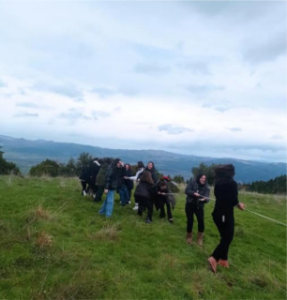
The Tug of War & Ecosystem Balance workshop was a sport-based, experiential learning activity implemented at K.E.PE.A. Stylidas-Hypatis, with students from the General Lyceum of Orchomenos, as part of the KA2 STELLA Project. The activity aimed to help students explore key environmental concepts such as cooperation, interdependence, and ecological balance through an adapted version of the traditional Tug of War game. By using physical engagement and teamwork, participants reflected on how collective action and cooperation are essential for maintaining balance in natural ecosystems.
Objectives:
The objective of this workshop was to explore the concepts of cooperation, balance of power, and interdependence within ecosystems through a physically engaging team activity. The aim was to help students understand that strength in nature is not defined only by size, but also by collaboration and collective action.
Desired outcomes:
- Understand the role of cooperation in maintainin gecological balance
- Recognize the importance of smaller species and collective forces in ecosystems
- Experience sustainability concepts through teamwork and physical interaction
- Reflect on fairness, balance, and mutual respect in both nature and society
Description and Implementation:
During the KA2 STELLA Project, and inspired by the Training of Trainers held in Malta, I implemented a creative adaptation of Tug of War, a traditional sport originating in Ancient Greece. The activity took place at the General Lyceum of Orchomenos.
Students were divided into two uneven groups: one larger but physically weaker, and one smaller but stronger. This intentional imbalance served as a metaphor for ecological systems. As the game progressed, students observed that cooperation, strategy, and coordination allowed the larger group to compete effectively against greater individual strength.
The activity was followed by a guided discussion connecting the game to real-life examples from nature, such as ants, bees, and other small organisms that achieve significant impact through collective action.
Feedback:
Students expressed high levels of enjoyment and enthusiasm, particularly appreciating the competitive element of the game. Many students commented that they liked learning through teamwork and physical challenge, and several were able to link the game experience to examples from nature discussed during the reflection phase.
Conclusion and Recommendations:
The Tug of War & Ecosystem Balance workshop successfully used a familiar and engaging sport to communicate complex sustainability concepts. Despite moments of heightened competition, the activity provided valuable learning opportunities, especially when combined with structured reflection and guided discussion. The experience reinforces the importance of clearly framing learning objectives and facilitating post-activity reflection to connect physical experience with environmental meaning. For the wider STELLA project, this workshop highlights how culturally familiar games, when thoughtfully adapted, can serve as powerful tools for environmental education and non-formal learning.